Corporate Wellness vs Corporate Well-Being: Why the Difference Creates Real Impact

TL;DR: Corporate wellness programs often stop at physical health, therapy, or perks. Corporate well-being goes deeper, integrating body, mind, nervous system, nutrition, energy, and culture. For businesses in Chicago (and across the nation) well-being is the smarter strategy for resilience, retention, and performance.

What’s the Difference (More Nuanced)

Wellness is no longer enough. Yes, mental health is part of wellness, but corporate well-being demands more: emotional alchemy, somatic awareness, nutrition education, and energy management…all focused on results.

Corporate wellness might offer therapy, gym benefits, or nutrition tips about calorie balance. Corporate well-being encourages people to go further: to understand their own nervous system, gut health, and emotional energy. It shifts the frame from managing symptoms to cultivating resilience and vitality.

Updated Table: Corporate Wellness vs Corporate Well-Being

Feature

Corporate Well-Being

Traditional Corporate Wellness

Focus

Holistic: nervous system regulation, emotional processing, somatic practices, social connection, nutrition, and financial health.

Narrower: physical health, therapy, fitness classes, basic nutrition advice.

Objective

Help employees thrive by cultivating resilience, energy, belonging, and values alignment.

Reduce healthcare costs and mitigate risk factors.

Practice

Includes somatic tools like breathwork, sensation awareness, posture shifts, energy resets, and nutrition education that emphasizes gut health and individual differences.

Standard offerings like health screenings, fitness challenges, and counseling.

Cultural Integration

Embedded into leadership, policies, and team norms; well-being becomes part of how business gets done.

Add-on programs that often feel optional or separate from work culture.

Nutrition

Teaching employees to understand their own system: gut health, digestion, blood sugar regulation, how nutrition impacts energy and mood.

Focus on basics like weight loss, calorie tracking, or “eat healthier” campaigns.

Energy

Central focus: cultivating and managing energy, learning to notice internal states, and making clear decisions from regulated awareness.

Overlooked; treated indirectly through physical health or rest.

Outcome Evidence

Research shows integrative practices (somatic regulation, mindful eating, emotional processing) reduce stress, improve productivity, and boost retention. (Frontiers in Psychology)

ROI studies show modest improvements, often limited by low engagement or lack of integration. (HBR)

ROI and VOI (Value)

Increases value on investment by enhancing morale, reducing turnover, and sustaining productivity.

ROI often measured in direct savings like healthcare or absenteeism, with softer cultural metrics ignored.

Evidence and Research: Why Well-Being Outperforms Wellness Over Time

  • A 2024 Wellhub survey found that 95% of companies measuring ROI in their wellness programs reported positive returns. Companies with holistic well-being offerings saw even stronger ROI, many reporting returns of 150% or more. (Wellhub)

  • Clinical work on somatic experiencing shows that treating post-traumatic symptoms through body awareness leads to reductions in anxiety and PTSD symptoms and improves emotional stability. (NIH)

  • Research in Frontiers in Psychology found that cultivating mindful awareness of bodily sensations improves emotional regulation and resilience. (Frontiers)

Why Chicago Matters — And Why We Work Nationally

Chicago is our home base and also one of the most competitive, high-pressure business markets in the country. Leaders here juggle the pressures of urban living, a diverse workforce, and the demand for results in a fast-moving economy. A well-being focus speaks directly to these challenges: burnout, retention, engagement, and resilience.

But these pressures are not unique to Chicago. Paradigm Rhyme delivers this work nationally, helping organizations in major metropolitan areas and across industries embed well-being into the way they work. What we teach is not regional. It is universal. It works anywhere leaders are ready to make well-being part of their strategy.

How Paradigm Rhyme Bridges the Gap

We build well-being into the flow of business. Not just perks, but systemic practices that allow people to reset, recover, and show up fully.

Our offerings include:

  • Pre-program assessments that measure stress, nutrition, energy, and emotional resilience

  • Sessions that combine executive coaching with body-based practices such as breathwork, somatic reset, and guided reflection

  • Integration of nutrition and energy awareness into leadership training and employee education

  • Follow-ups, small group practices, and consulting to help leaders weave well-being into everyday culture

Closing

Corporate wellness is a start. Corporate well-being is the evolution. It expands the frame to include not just body and mind, but nervous system, nutrition, energy, and emotion.

Paradigm Rhyme helps leaders and organizations move from surface-level wellness to true well-being: where individuals thrive, teams connect, and organizations perform at their peak.

Whether you are leading a Chicago-based company or a national enterprise, the truth is the same: when employees are supported holistically, performance follows.

Corporate Well Being: Hope as a Competitive Advantage in 2025

I was walking to Equinox after a long week of splitting my time across multiple well-being ventures and working with new clients when I came across an article by Suzy Welch. She pointed out that Gen Z and millennials are often accused of being lazy, entitled, or not caring about work. We’ve all heard those stereotypes: they don’t want to grind, they want too much too soon, they lack resilience. But what if those labels miss the truth? What if what we’re really seeing isn’t apathy, but a deeper lack of hope? This conversation gets to the root of corporate well being today.

Older generations made a bargain with the system: work hard, stay loyal, and you will be paid back in return. The corner office, the pension, the stability. For decades that belief carried people through long hours and personal sacrifice. But recent decades have shown this bet was folly. The loyalty between employee, organization, and government oversight has frayed. Layoffs, broken promises, rising costs, and shrinking security revealed that the system wasn’t designed to give back what people were putting in.

Gen Z has grown up watching that unravel. If they seem disengaged, it may not be because they don’t care. Part of it is likely because hope itself has been shaken. And when hope goes, everything else follows: motivation, energy, trust, engagement. We hear a lot today about late-stage capitalism, burnout rates above 70%, rising mental and physical health challenges. Harvard researchers call burnout the defining workplace crisis of our time. It is past time for a reset. A new way. Wise leaders are beginning to figure this out.

Hope Is More Than a Feeling

Hope is not fluff. It is not optimism with rose-colored glasses. Hope is a cognitive-emotional skill that can be cultivated.

Psychologists define hope as the belief that you can find pathways to your goals and the motivation to pursue those pathways. It combines vision with energy. Neuroscience shows that when people experience hope, the brain’s reward circuitry lights up. Dopamine flows. Motivation rises. The body literally prepares itself to move forward.

But hope becomes really hard when your nervous system is working against you. When you’ve seen the same bad results over and over again, the body shifts into survival mode. The fight-or-flight cycle hijacks attention. You stop imagining new possibilities because your brain is locked in replaying old failures.

This is why burnout is not solved by a vacation or a perk. Burnout is a hope problem. It is the body’s way of saying, “I no longer believe this effort will lead to change.”

Stories of Hope Against the Odds

Business is full of stories of leaders who kept going when hope seemed impossible:

  • Howard Schultz grew up in Brooklyn housing projects and nearly gave up on his idea of building Starbucks into a coffeehouse empire. Banks rejected him repeatedly. But his hope that coffee could become community kept him moving until investors finally listened.
  • Sara Blakely, founder of Spanx, heard “no” from manufacturers for months while working out of her apartment. Hope, in the form of a vision of women everywhere benefiting from her product, fueled her persistence until she became the youngest female self-made billionaire.
  • Oprah Winfrey overcame poverty, systemic bias, and countless professional setbacks. She held onto the vision that storytelling could heal and connect people. That hope turned her into one of the most influential voices on the planet.
  • Reed Hastings at Netflix endured near-bankruptcy, a failed DVD business model, and waves of skepticism before streaming caught on. His persistence in the vision of accessible entertainment is now industry-defining.

These are not fairy tales. They’re reminders that when hope is alive, possibilities expand.

Eckhart Tolle and the Dark Night of the Soul

Eckhart Tolle, the author of The Power of Now, tells the story of how he hit rock bottom in his late twenties. He was consumed by depression and anxiety, living with the constant thought, “I cannot live with myself any longer.” In that moment of despair, something shifted. He realized that if he could not live with himself, then perhaps there were two “selves” inside him — the conditioned mind and the deeper awareness.

That realization cracked him open. Hope returned, not as “things will get better out there,” but as “I can live differently in here.” From that point forward, his life changed course. He became one of the most influential spiritual teachers of our time.

The lesson? Hope often begins when the old way collapses.

Nelson Mandela: Hope in the Harshest Conditions

Few stories embody hope like Nelson Mandela’s. Imprisoned for 27 years, he endured isolation, harsh conditions, and countless moments where despair would have been natural. But Mandela held onto hope — not passive waiting, but active faith that his struggle was part of something bigger.

When he walked free in 1990, he carried that hope into building a new South Africa. His ability to forgive, to unite, to lead with vision was born from the furnace of those years. Mandela’s story is proof that hope is not naive. It is powerful, practical, and world-changing.

Why Hope Matters in Business Today

How does all this fit back into corporate well being? We are in a time when society feels fractured. Unity feels distant. In Chicago, across the nation, and globally, tensions are high. Businesses sit in the middle of this storm. Employees bring their fears, anxieties, and exhaustion to work. Leaders feel the squeeze of expectations from above and pressures from below.

Harvard’s studies show that burnout is not just an individual issue. It is systemic. Organizations that ignore hope pay the price: turnover, low engagement, poor performance.

The silver lining? Hope can be built. It can be designed into systems. It can be trained into leaders. It can be embodied in teams.

At The Space for Business here in Chicago, we help organizations embed well-being into the flow of work. We design programs that connect performance to human rhythm. Leaders learn to model hope, to hold space for emotions, to redesign systems so that people believe again.

At Paradigm Rhyme, we take this nationally and individually. We coach entrepreneurs, executives, and high performers to heal the nervous system, to reframe conditioning, to build emotional resilience. We blend science and somatic practices — breathwork, meditation, movement, journaling — with executive expertise.

When people regulate their bodies, they reclaim hope. When organizations redesign their systems, they multiply hope.

From Burnout to Breakthrough

I’ve worked with executives who thought their best days were behind them. They were burned out, disengaged, ready to walk away. Through our work, they discovered the patterns in their nervous system that kept them stuck. They learned tools to regulate, to reset, to dream again. And suddenly, the spark returned.

I’ve seen teams who had lost faith in leadership transform when leaders became transparent, when emotions were acknowledged, when well-being was prioritized. The shift from despair to hope is not subtle. It’s the difference between surviving and thriving.

Building Hope as a Daily Practice

Hope is not a one-time event. It is a practice.

  • Gratitude shifts the nervous system into possibility.
  • Breathwork resets the body and clears space for vision.
  • Reflection helps people connect their daily actions to their bigger why.
  • Ritual creates stability that allows for growth.

Famous leaders like Oprah Winfrey, Richard Branson, and Vishen Lakhiani of Mindvalley all emphasize daily practices as the anchor for hope and vision. Ritual is how hope becomes embodied. James Clear’s Atomic Habits reinforces the same point: tiny, consistent actions compound into transformation.

The Invitation

This time in history is tough. The noise, the uncertainty, the division are real. But what if hope became your competitive advantage in 2025?

Not passive hope, waiting for the world to change. Active hope. Hope built into systems. Hope practiced in daily rituals. Hope designed into leadership.

At Paradigm Rhyme and The Space for Business, this is what we do. We help people and organizations move from burnout to breakthrough. From surviving to thriving. From losing faith to rediscovering hope.

Because when individuals have hope, teams connect. When teams have hope, organizations thrive. And when organizations thrive, society has a chance to heal.

Angle 3: Formulas for Success

Formulas for Success: Discovering Your Unique Code for Thriving

TL;DR

Success isn’t about hacks or hustling harder. It’s about aligning with timeless natural laws and proven practices that make life flow in your favor. At Paradigm Rhyme, we call these codes—formulas that dissolve resistance, amplify energy, and make success repeatable. Everyone’s code looks a little different, but the process of finding yours is universal.


How Angle 3 Fits With the Others

If you’ve been following along in this series, you know we’ve already explored Angle 1: You & the World Around You and Angle 2: Paradigm. Think of them as the foundation and the operating system.

Here’s the truth: you can’t just drop good code into a bad system and expect it to run smoothly. If your hardware—your body, nervous system, and mind—is fried, even the best formulas won’t stick. And if your operating system—the paradigms, beliefs, and unconscious patterns running in the background—is outdated, the code won’t execute as intended.

That’s why Formulas for Success is Angle 3. Once your instrument is tuned (Angle 1) and your paradigm upgraded (Angle 2), these codes land deeper and hold longer. They shape how you experience life moment-to-moment, and they reinforce the paradigm you’re already running on.

Think of these formulas as the software layer. They don’t replace the system—you still need good hardware and a solid OS—but they transform raw potential into real, repeatable results.


Why Formulas Matter

We live in a culture obsessed with hacks. “Top 10 ways to optimize your morning routine.” “The 5-minute trick that billionaires swear by.” “Biohack your way to focus.” If any of those really worked long-term, we’d all be walking around enlightened, energized, and effortlessly successful. But most people I meet are still burned out, anxious, and trying to force outcomes.

Here’s why: hacks don’t change the system. They’re like trying to put a turbocharger on an engine that hasn’t had an oil change in five years. It might rev louder for a minute, but eventually the whole thing seizes up.

Formulas are different. They’re not gimmicks. They’re not shortcuts. They’re timeless principles of how life actually works—principles the sages and yogis understood thousands of years ago, and that modern psychology and neuroscience are now catching up to.

Take gratitude, for example. The Stoics talked about cultivating contentment with what is. Yogic philosophy pointed to non-attachment as a path to freedom. Today, Harvard studies show that two weeks of gratitude journaling measurably increase optimism and reduce doctor visits. Different cultures, different eras, same formula: attention + appreciation = resilience and joy.

Here’s the kicker: formulas multiply when applied correctly. Think of them as codes that interact with your body (hardware) and your paradigm (operating system). When you practice them consistently, they don’t just add up—they compound. They unlock energy, dissolve resistance, and make the game of life a lot smoother.

This is why Formulas for Success matter. They’re not quick fixes, they’re operating instructions. Get them right, and you stop white-knuckling your way through life. You start flowing with it.


The Happiness Formula

Let’s start with the most chased, most misunderstood formula of them all: happiness. Most people treat happiness like a prize at the end of the marathon. Once I hit the number in my bank account, then I’ll be happy. Once my business scales, then I’ll be happy. Once I find the right partner, then I’ll be happy.

Here’s the truth: happiness isn’t the reward. It’s the foundation. Without it, even your biggest wins feel hollow.

I learned this lesson the hard way. When I was climbing the corporate ladder, I thought each promotion or pay raise would be the thing that finally filled the gap inside. The external markers stacked up, but the internal satisfaction never arrived. It wasn’t until I began building practices of self-compassion, presence, and gratitude that success started to feel like success.

Neuroscience backs this up. When you practice gratitude, your brain literally rewires itself to release dopamine and serotonin—the same chemicals tied to motivation and joy. When you drop attachment and stop clinging to outcomes, your nervous system shifts from survival mode into flow. Happiness, it turns out, is not abstract. It’s trainable.

At Paradigm Rhyme, we use a simple equation:

Happiness = (Paradigm + Acceptance + Presence + Purpose) – Attachment

It’s not math you can plug into a calculator, but it’s a framework that works in the real world. Align your paradigm, practice acceptance, stay present, live with purpose—and release the death grip on how outcomes must look—and suddenly happiness stops being elusive. It becomes a baseline you can build on.

Because when happiness becomes your foundation, success stops being something you chase. It becomes something you create.


Redefining Success

Most of us grew up with a pretty narrow definition of success: money, titles, recognition, maybe a corner office with the skyline view. And don’t get me wrong—those things can be satisfying. But I’ve worked with enough executives, founders, and high performers to know that plenty of people who “make it” still feel empty inside.

The problem isn’t that success is bad. It’s that the old definition is incomplete. If your version of success is built on external validation alone, it will always feel fragile. You’ll keep moving the goalposts, chasing the next promotion, the next investment round, the next accolade. And every time you arrive, the finish line moves again.

Here’s what I’ve learned: real success is progress toward a worthy ideal. Not someone else’s definition. Yours. For me, that shift happened when I stopped measuring myself only by corporate advancement and started aligning my work with purpose. The external wins didn’t disappear—I still wanted growth, clients, and recognition—but suddenly those things were in service of something deeper, not substitutes for it.

When you redefine success around authenticity, the game changes. It stops being about climbing someone else’s ladder and becomes about building your own path. And here’s the paradox: when you stop hustling for the shiny outcomes and start aligning with what’s real, the external markers tend to follow anyway.

Failure also starts to look different. Instead of being a verdict on your worth, failure becomes feedback—information you can use to refine your formula. In other words: failure is mostly an illusion. The only way you truly fail is by living someone else’s definition of success.


Purpose × Passion

If redefining success sets the direction, then Purpose × Passion is the engine. It’s the overlap of what you love, what you’re good at, and what the world needs. When you find that sweet spot, energy multiplies.

Most people treat purpose and passion as two separate things. Purpose feels heavy—like duty, legacy, or obligation. Passion feels lighter—like hobbies, creative flow, or what you’d do for free. But when you bring them together, you get something sustainable. Purpose fuels passion with meaning. Passion fuels purpose with energy.

Think of it as a multiplier, not an addition:

Purpose × Passion = Sustainable Drive

I’ve seen this play out again and again. One client of mine had built a successful coaching practice, but she felt drained. She realized her purpose was guiding leaders, but her passion was creative expression. By weaving storytelling, poetry, and art into her coaching, her work stopped being a grind and started feeling alive. She didn’t just get more fulfillment—her business grew, because clients could feel the authenticity.

I’ve lived this formula too. When I was running on purpose without passion, I burned out. When I chased passion without purpose, I lacked direction. But when both clicked, the work became magnetic. Doors opened. People noticed. The effort felt less like effort, and more like flow.

Your formula won’t look exactly like mine—or anyone else’s. That’s the point. Authenticity is your ultimate success code.


Emotional Alchemy

Every entrepreneur, creator, or leader I’ve worked with eventually hits the same wall: emotions. Fear before the launch. Anger when something falls apart. Grief when a dream doesn’t unfold the way you hoped. Most people try to suppress these emotions, thinking they’re weaknesses or distractions. But here’s the truth: emotions are energy. And energy can be transformed.

That’s what I call emotional alchemy. It’s the process of turning difficult emotions into fuel for growth, creativity, and clarity. Instead of resisting fear, you learn to breathe into it and find the message it carries. Instead of being consumed by anger, you channel its intensity into creating boundaries or driving change. Instead of being stuck in grief, you allow it to open compassion and deepen your sense of purpose.

Neuroscience supports this. When you reframe emotions, you literally create new neural pathways in the brain. Fear that once triggered paralysis can, with practice, trigger curiosity or preparation. Anger that once erupted destructively can be rerouted into clear, assertive communication. This isn’t just mindset—it’s rewiring at the deepest level.

I’ve seen this shift change everything. A client once told me he dreaded pitching investors because of his fear of rejection. Through emotional alchemy, he learned to see fear not as a stop sign, but as a signal: “This matters. I care. My body is preparing me to rise.” His pitches transformed. Not because the fear disappeared, but because he transmuted it into presence and conviction.

The gold is always hidden in the shadow. When you stop running from dark emotions and start working with them, you unlock an endless well of energy. Fear becomes creativity. Anger becomes courage. Grief becomes wisdom. That’s emotional alchemy.


Tools to Thrive

Formulas are powerful, but they only take root through practice. You can understand gratitude in theory, but until you write it down, speak it, or feel it in your body, it remains an idea. That’s why thriving requires tools—practical practices that turn codes into lived experience.

Some of my go-to tools include:

  • Breathwork → Fastest way I know to reset the nervous system. Six minutes of coherent breathing can shift you from fight-or-flight into balance. I’ve used it before client calls, tough conversations, even mid-flight when anxiety hit. Every time, it brings me back online.

  • Meditation → Not about clearing your mind, but training your attention. Even ten minutes of noticing your breath or body sensations teaches you to stop being pulled by every external distraction.

  • Somatic Resets → Quick movements, shaking, or tapping to discharge stress your body holds. Animals do this naturally. Humans forget. But every time you give your body permission to reset, you prevent stress from calcifying into burnout.

  • Journaling → Sounds simple, but writing thoughts down creates space between you and them. A page a day has saved me more than a few sleepless nights.

I once walked into a boardroom after a tough morning where everything went wrong—late train, broken laptop, bad news text. Old me would’ve carried that stress into the meeting. Instead, I stepped aside, did a few minutes of breathwork, and reset my system. I walked in clear, grounded, and led with presence. The difference wasn’t subtle; the energy of the room shifted with me.

These tools are not extras. They’re the practices that make the formulas stick. Without them, codes remain theory. With them, they become embodied. And once embodied, they start reshaping your paradigm automatically.


The Law of Vibration

Here’s where things can sound “woo” if you’ve only heard it on Instagram, but let’s ground it in both ancient wisdom and modern science. The Law of Vibration says that everything is energy. Your thoughts, emotions, and even your physical body all vibrate at certain frequencies. And those frequencies influence the experiences, people, and opportunities you attract into your life.

At first glance, this can sound mystical. But think about it: neuroscience has shown that your brain is constantly predicting and filtering reality. If you’re tuned to fear, you literally see more threats. If you’re tuned to gratitude and possibility, your brain’s reticular activating system starts filtering the world to find matches. Energy shapes perception. Perception shapes choices. Choices shape results. That’s vibration in action.

I’ve lived this in my own journey. When I was laid off, my vibration was initially fear and scarcity. I thought I had to scramble to find the next safe job. But when I shifted—through breathwork, meditation, and reconnecting to purpose—suddenly doors opened that I never could have forced. The projects, people, and opportunities that came my way matched the energy I was holding.

I’ve seen it with clients too. One founder I worked with was pushing so hard for a corporate partnership that she was repelling the very relationships she wanted. Once she shifted her vibration—stepping into confidence and ease rather than desperation—the calls and connections started landing. Not because the universe magically delivered, but because her energy changed the way she showed up, spoke, and built trust.

The yogis talked about vibration thousands of years ago. The Yoga Sutras point to samskaras—energetic imprints that shape experience. Zen teachings emphasize dropping resistance so you can flow with reality. Even Jesus said, “Ask and it will be given to you”—a vibration principle if there ever was one.

When you understand vibration, you realize it’s not about forcing outcomes. It’s about tuning yourself. Like a radio, you attract what you’re broadcasting.


Building

Your

Formula

Here’s the liberating truth: there is no one-size-fits-all formula for success. If there were, every self-help book, productivity hack, and motivational seminar would have already solved the problem. Your formula won’t look exactly like mine—or anyone else’s. And that’s the point.

Formulas for success are deeply personal. They’re about authenticity—living in alignment with who you actually are, not who you think you “should” be. Some people thrive with highly structured routines. Others need flexibility and freedom. Some find energy in groups, others recharge in solitude. The work isn’t to copy someone else’s formula—it’s to uncover your own.

Here are a few prompts to help you start sketching yours:

  • What energizes me naturally? Pay attention to the activities that light you up versus the ones that drain you.

  • Where do I feel most authentic? Notice the environments, people, and practices where you feel fully yourself.

  • What practices reliably bring me back to center? Think breathwork, journaling, movement—tools that reset your system when life throws curveballs.

  • What outcomes actually matter to me? Strip away the “shoulds” inherited from culture, family, or social media.

The process is iterative. You don’t discover your formula overnight—it evolves as you grow. What worked for you last year may no longer fit today. And that’s not failure, that’s proof you’re alive and adapting.

When you treat life as an experiment, you give yourself permission to test and refine your code. Every reflection, every practice, every course correction is a line of code shaping your unique operating system.

Authenticity isn’t just nice to have—it’s the ultimate success code.


Why This Matters Now

It’s tempting to think all of this—formulas, codes, vibration, emotional alchemy—is just “personal development.” But it’s much bigger than that. The way we live, work, and create in 2025 demands a new approach to success.

The stats paint the picture clearly:

  • 83% of U.S. workers report workplace stress (OSHA).

  • Depression and anxiety cost the global economy $1 trillion per year in lost productivity (WHO).

  • Half of U.S. adults live with high blood pressure and most don’t even know it (CDC).

On paper, humanity is producing more than ever before. AI is coding, diagnosing, even creating art. But what’s the cost? Anxiety is spiking, burnout is normal, and many people feel like they’re running faster but getting less fulfillment .

That’s why these formulas matter. The old game was about more output—work harder, produce faster, chase external success. The new game is about alignment. Machines can out-produce us in countless ways. But they can’t feel, they can’t intuit, they can’t rewire trauma or transmute grief. Our edge as humans is our ability to live consciously—to tune our hardware, upgrade our paradigm, and apply the right codes.

This isn’t just about feeling better (though that’s a worthy goal). It’s about creating a life—and a society—that actually works. When you practice these formulas, you don’t just get personal breakthroughs. You show up differently in your relationships, your business, and your community. You lead with clarity instead of fear. You create from authenticity instead of ego.

In a world drowning in hacks, speed, and surface-level success, this is the deeper revolution: learning to thrive by design.


Your Code, Your Life

Formulas for success aren’t abstract—they’re daily operating instructions. They’re the patterns that help you turn chaos into clarity, resistance into flow, and pressure into purpose.

When your hardware (body, mind, nervous system) is tuned, and your operating system (paradigm) is upgraded, these codes are the software that brings everything to life. They don’t just help you “get by.” They help you thrive.

Your formula won’t look like mine. It won’t look like anyone else’s. And that’s exactly the point. The closer you get to your authentic code, the more life starts working with you instead of against you.

Because in the end, success isn’t about chasing what looks good on the outside. It’s about discovering and living the formula that makes you come alive on the inside. And when you do that, the external wins have a way of showing up too.

Authenticity is the ultimate success code. The invitation now is simple: start experimenting, start aligning, and start writing yours.
Angle 2: Paradigm, The System Beneath Everything

TL;DR (for my fellow high-performers who skim first, then maybe circle back later):

Your life runs on a hidden operating system called paradigm. It’s built from your nervous system (which equates “change” with “danger”), the culturescape you grew up in, and the ego that will do anything to protect the familiar. That’s why willpower and New Year’s resolutions rarely stick — the old code pulls you back.

At Paradigm Rhyme, we break it down into six parts: Beliefs, Stories, Habits, Body, Relationships, and Results. If you don’t shift the paradigm underneath, your outcomes will keep looping. Change the paradigm — through somatic practices, mindset rewiring, and conscious design — and you stop settling for “good enough.” You start living as the author of your life, not the operator of old programming.


The Paradigm System

Your nervous system is always trying to keep you safe. But “safe” to the nervous system usually means “don’t change.” It wants you to stick with the familiar, even if the familiar is not serving you. Growth feels risky to the body. Layered on top of that is our conditioning. Every one of us is shaped by a culturescape — the beliefs, expectations, and “rules” of the families, communities, and societies we grew up in. These cultural codes silently train us in what’s “normal,” what’s acceptable, and what’s possible.

then there’s the ego. The ego is a mental construct, designed to protect itself. Change to the ego feels like death, so it resists by generating fear. It pushes us back toward the known, even if the known is exactly what’s keeping us stuck. Together, the nervous system, the culturescape, and the ego create a powerful inertia toward the status quo. Which is why so many people find themselves repeating the same cycles year after year, wondering why progress feels impossible. This is where Paradigm comes in. Paradigm is the hidden force dictating almost everything in life. It’s the operating system running underneath your thoughts, actions, and results.


The Six Parts of a Paradigm

At Paradigm Rhyme, we break a paradigm into six interconnected parts:

The Four Primary Factors

  • Beliefs: Mental programs that shape what you see as possible.
  • Stories: The narratives you tell and retell that either trap you or free you.
  • Habits: The small daily actions reinforcing old cycles or opening new ones.
  • Body: The foundation where stress, trauma, and energy live, and where transformation begins.

The Two Reinforcing Outcomes

  • Relationships: The people and communities who mirror and reinforce your paradigm, either expanding you or pulling you off center.
  • Results: The visible outcomes that show exactly what paradigm is running in the background.

These parts are not separate — they constantly interact and reinforce each other. Beliefs shape stories. Stories drive habits. Habits and stress live in the body. Your body and energy field shape the relationships you attract and the results you produce. Change in one dimension creates ripples in the others.

This is why Bob Proctor’s famous words are so true: “You don’t get what you want. You get what you are.” If your paradigm doesn’t shift, your results will keep looping, no matter how hard you hustle or how many goals you set.


Why Most Change Doesn’t Last

Every January, gyms fill up with new members. By February, most are gone. Professionals set ambitious career goals but stay in the same jobs for years. People commit to therapy, but sometimes cycle through the same stories for decades.

The reason is not laziness or lack of willpower. It is paradigm. If the paradigm underneath does not shift, the old code overrides the new intention. The subconscious always wins. Research from Yale shows that as much as 95 percent of human behavior is driven by subconscious programs (Bargh & Chartrand). That means most of what you do each day is autopilot. Only a tiny fraction of your choices are truly conscious. Unless the paradigm changes, new goals eventually get pulled back into the old gravity.

And here’s the tricky part: it can be hard to convince someone of this truth precisely because of how strong their paradigm is. The ego resists change because change feels like death to it. Conditioning tells us to defend the familiar even when the familiar is suffocating us. Paradigms are sticky, powerful, and invisible. When you start peeling away at the edges, creating cracks in the armor, the whole structure begins to unwind. That process can be uncomfortable, even painful. But on the other side of that unraveling is something most people have never actually touched: themselves.

If you wonder how some of the most headstrong figures in history — Hitler, Stalin, Mao, Hussein, or Ghaddafi — could justify their choices, it comes down to paradigm. And the same is true for figures like Robert E. Lee, Tom Daschle, Donald Trump, Elon Musk, or the most celebrated humanitarians and moral leaders. No exceptions. Paradigm explains it every time. There is always a logical rationale inside their operating system that makes the behavior make sense to them.

Change your paradigm and you change your life. Leave the paradigm untouched, and even the best strategies, intentions, or resolutions will get absorbed back into the old code.


The Role of the Body

A lot of self-help work stops at the mind. But your paradigm is not just mental — it is embodied. Anxiety feels like a tight chest. Shame shows up as a flush in the skin or a gut punch. Stress loops through tense shoulders and shallow breathing. These are not abstract concepts. They are physiological patterns playing out inside the body.

This is why somatic practices like breathwork, movement, meditation, and energy work are essential. They rewire the body’s role in the paradigm. Without addressing the body, the other shifts do not hold. And this is not woo — it is science. Research shows that somatic practices improve heart rate variability (HRV), help resolve trauma symptoms, and regulate emotional states (NIH, Polyvagal Theory, The Body Keeps the Score).

In a recent blog, Finding Balance in the Ultra-Modern World, I went deeper into this. The nervous system that once helped us survive predators in the jungle now struggles under emails, deadlines, social feeds, and information overload. At our core, we are mammals. When a gazelle escapes a lion, its body shakes off the adrenaline and resets. When a bear emerges from hibernation, it discharges built-up energy before resuming life. But humans often never complete the cycle. We stay in fight-or-flight mode, scrolling, stressing, and pushing forward without release.

Ancient cultures knew this. Whether through drumming, dancing, or storytelling around the fire, they built practices to move stuck energy and restore balance. Today, somatic therapies like Somatic Experiencing and breath-based practices are giving us the same tools, backed now by neuroscience and clinical research.

The body is not separate from the paradigm. It is the foundation. Change the body, and suddenly beliefs, stories, habits, relationships, and results all have space to shift. Leave the body out, and you are trying to run new software on old hardware.


Breaking Free from “Good Enough”

The real trap of an old paradigm is not total failure — it’s settling. Settling into jobs that look fine on paper but feel dead inside. Settling into relationships that are “ok” but not truly alive. Settling into routines that keep us safe but not fulfilled.

This is why so many high performers quietly confess they feel stuck. They’re running a paradigm built for survival and productivity, not one built for thriving. Until the paradigm changes, “good enough” becomes the ceiling.


Building a New Paradigm

The invitation of 2025 is to stop running the old code. The nervous system work, the somatics, the mindfulness — these are not isolated practices. They are tools to reprogram the paradigm.

When you start shifting beliefs, rewriting stories, building new habits, curating relationships, healing the body, and focusing on aligned results, life stops being an endless cycle of reaction. It becomes conscious creation.

This is not about rejecting the past. Many traditions, rituals, and lessons are worth carrying forward. But it is about stripping away what no longer serves, integrating the best of ancient wisdom and modern science, and writing a new paradigm that actually supports human thriving.

Because in the end, you don’t get what you want. You get the results your paradigm is wired for. Change the paradigm, change everything.


Angle 1: You & The World Around You

Angle 1: You & The World Around You

Aligning Body, Mind, and Energy so Real Life Actually Feels Good
TL;DR (for my execs on airplanes):
If your body is fried, your mind’s on autopilot, and your energy is jammed, no strategy deck will save you. Tune your nervous system, retrain your thinking, and align with the way the world actually moves. Then the metrics follow—without you white-knuckling your way there.

The Night I Tried to Outrun My Own Body
A few years back I was doing that very professional thing where you “just power through” after dark. My body was throwing up every dashboard light—shoulders tight, eyes gritty, brain operating like a 2008 laptop with 47 Chrome tabs open. Naturally, I ignored all of it. I kept pushing, the work quality dipped, and I bought myself a bonus problem: a worse tomorrow.

That night taught me something embarrassingly simple: fatigue is not a moral failing—it’s a useful signal. The next morning, after real sleep, the solution I needed took twenty minutes. It wasn’t “discipline” I lacked; it was respect for my physiology.

Another lesson arrived later: I kept forcing myself to love deep analytical work because I thought I “should be good at it.” I could do it, sure—but it cost me. I was proving something no one had asked me to prove. When I finally let other people lead where they’re brilliant, my energy (and results) lifted. Novel idea: stop swimming upstream in the wrong river.

This is Angle 1 in action—You & the World Around You—and it starts with a body that you can actually hear, a mind that serves you instead of hijacking you, and an energy field that flows with life rather than fights it.

What We’re Really Doing Here
Think of Angle 1 as tuning the instrument. If your body is the cello, your mind is the musician, and your energy is the resonance that fills the hall. When all three line up, ordinary days get a lot lighter and big days get a lot more possible.
We’ll explore four dimensions:
Body Connection — nervous system regulation, somatics, intuitive listening.

  1. Mind Mastery — upgrading the mental programs that run by default.
  2. Physical World Experience — redefining success, leading with feeling, taking aligned action.
  3. Energetic World — the science-meets-mystical layer: vibration, attraction, synchronicity.

You’ll see research, some book references, and plenty of lived experience. Sprinkled with jokes, because the ego is hilarious when you catch it in the act.

1) Body Connection: Your Body is not In the way—it is the Way

When you’re exhausted, your body is not “being difficult.” It’s being accurate.
Somatic pioneers like Dr. Peter Levine (Waking the Tiger) show how the nervous system holds incomplete stress cycles that need completion—not analysis. When gazelles escape a predator, they tremble and discharge energy; then they go back to grazing. Humans? We open Slack and rehearse the event 16 times. (Elite sport called rumination—I was captain.)

What Listening Looks Like (in real life)

  1. Breathwork to downshift: 4–6 minutes of gentle nasal breathing, longer exhales than inhales.
  2. Micro-movement: slow spinal waves, shoulder circles, a quick walk without your phone.
  3. Sound and stillness: bowls, a track that moves you, or literal silence.
  4. Cold water or heat: a brisk shower or sauna to wake the body’s natural regulation.
  5. Reiki / energy hygiene: not mystical performance art, just nervous system care.

I use all of these. They’re not “nice to have”—they’re operational hygiene.’

Try this (2 minutes): Put a hand on your chest and one on your lower belly. Inhale softly through your nose, exhale like you’re fogging a mirror but through your nose. Six breaths. Notice what changes.

Intuition Is a Body Skill
Michael Singer (The Untethered Soul) talks about the inner voice that narrates your entire life. Under that voice is sensation—your body’s vote. Tight throat? That’s a “no.” Spacious chest? That’s a “yes.”
Resources like The Secret Language of the Body (Jennifer Mann) invite us to consider the meaning we might be storing in tissue. Whether or not you read it literally, inquiring into sensation is powerful coaching: “What is my body saying right now, and what would honoring it look like?”

The ROI of Regulation

Regulation isn’t just about feeling good; it’s performance. When my body is settled:
I say no faster.

I delegate sooner.

Creativity returns.

Meetings shorten because I’m not managing my own reactivity the whole time.

Executive translation: regulated nervous system → fewer dumb decisions → better outcomes with less drama.

2) Mind Mastery: Rewriting the Operating System
Confession time: I used to care a lot about what successful people thought of me. I also treated every business situation like my personal rescue mission. Autopilot. Gold star chaser. Chief Firefighter. Noble. Exhausting.

The pivot wasn’t an overnight epiphany; it was a thousand tiny reps:

  1. Gratitude each morning (before the phone): three specific things, feel them in the body.
  2. Trigger spotting: “Oh, that zing in my solar plexus? That’s my ego, not a federal emergency.”
  3. Shadow boxing: mental rehearsal of success, not just in images but in felt experience—the posture, the breath, the voice tone of the future me.

Maxwell Maltz wrote about this in Psycho-Cybernetics: the mind is a goal-seeking mechanism trained by imagery and emotion. Vishen Lakhiani calls it “consciousness engineering”: deliberately designing beliefs and models that work.

A Playful Way To Talk About Ego
We all admit ego exists… until someone steps on ours. Then suddenly it’s DEFCON 1. My working theory: ego spikes are energy reminders—a flare saying, “There’s charge here. Go clear it in the body.” Laugh at it, then metabolize it.

Try this (90 seconds): Name your ego like a character. (“Chad,” “Captain Good Boy,” “The Board of Directors.”) When you feel the surge, say, “Thanks for your input, [Name]. I’ve got the wheel.”

Mindset ≠ Thoughtwashing
This is not “think happy thoughts.” It’s precision:
Notice the story.

Feel the body.

Choose a better story that your nervous system can believe.

Take a tiny aligned action to prove it true.

Do that 10,000 times and yes, you become “lucky.”


3) Physical World Experience: Redefining Success & Leading Like a Human


Past me: success = titles, timelines, and being universally impressive.
Current me: success is progress toward a worthy ideal—deeply personal, internally referenced, and immune to comparison. Failure? Mostly an illusion we hand ourselves because a timeline was arbitrary or someone else’s goal seeped into our brain.

Surrender That Actually Works (and isn’t code for “do nothing”)

I’ve watched rooms change when I stopped forcing it:

  • Careers: my only layoff became the doorway to the life I actually wanted.
  • Consulting: I was rejected for a project I thought I needed at Deloitte… and got placed with the partner of my dreams.
  • Projects: we loosened the death grip on a launch date and focused purely on serving real people. The right timing revealed itself, quality went up, and yes—revenue followed.

Perfectionism is not excellence. Perfection is the enemy of shipped.

Lead With Feeling (Yes, in Business)
When I coach leaders, I ask a “forbidden” question: How do you want to feel while you create results?
Replace “Be the #1 provider in this region” with “Consistently surpass customer expectations while increasing revenue.”

Replace “Crush the competition” with “Build the most trusted solution in our market.”

Same ambition, different nervous system imprint. Teams move faster when the target feels good.
Mihaly Csikszentmihalyi’s research on flow shows we do our best work where challenge meets skill, with clear goals and immediate feedback. Translation: stop trying to live in permanent crisis mode. Design your days for flow conditions.

Try this (3 minutes): Write the three emotional states you want to feel while working this quarter (e.g., clear, energized, connected). Ask: What is one small daily behavior that would make each state more likely? Do those, not 17 more hacks.

4) The Energetic World: Where Science Meets the “Mystical”


Let’s get honest: a lot of what modern science now validates sounded like magic two generations ago. (Quantum weirdness, anyone?) I like living at the overlap—where ancient wisdom and data high-five.
Vibration & Attraction (Minus the Eye Roll)

“Law of Vibration” and “Law of Attraction” can sound woo until you translate them:

Attention is a filter.

Emotion is fuel.

Behavior is the proof.

What you continuously attend to (with emotional charge) shapes your perception, your choices, your micro-actions—eventually your results. The “universe” didn’t deliver; you tuned your system and moved differently.

Zen points at this in its own way: the moment you drop your argument with reality, you start seeing clearly. The Yoga Sutras talk about stilling the fluctuations of the mind so you can perceive truth. In the Sermon on the Mount, there’s a simple operating instruction: seek first the inner kingdom—get your inner world right, and the outer tends to line up.

Synchronicity: Not Coincidence—Coherence
Some of my best turns came disguised as closed doors. That layoff? It rewired my map. The Deloitte “no”? It lined me up with a better “yes.” Was it magic? Maybe. Was it coherence—my inner state aligning with a path that actually fit? Also yes.

Try this (2 minutes): Before a big decision, ask: If this were easy and aligned, how would it unfold? Then take the smallest step that fits that answer. Stop wrestling with doors that clearly want to stay shut.

Putting It Together: Your Lived Day
Here’s how Angle 1 becomes Tuesday, not theory.

Morning (10–20 minutes)

  • Gratitude (3 specifics; feel each for 10 seconds).
  • Breathwork (6–10 gentle breaths with longer exhale; or a short energizing practice if you’re sluggish).
  • Shadow Boxing (60–90 seconds) — see and feel yourself succeeding at one concrete thing today. Anchor it in your posture, breath, and voice.

Midday (5 minutes)

  • Walk without your phone. Let your eyes go wide (soft focus) to downshift your nervous system.
  • Check posture. Release the jaw.

Trigger Moment (on demand)

  • Name the ego character. Thank it. Breathe low and slow for four cycles.
  • Ask: what is this reaction teaming me?
  • Experience: the emotion until you can separate yourself from the energy
  • Ask: What would the regulated version of me do next? Do that.

Evening (10 minutes)

  • One line in a journal: Where did I ignore my body today? Where did I honor it? Adjust tomorrow
  • Body scan in bed. Notice charge pockets; breathe into them.

None of this is glamorous. All of it is game-changing.

Common Detours (and How to Laugh Through Them)
“If I stop pushing, nothing will get done.”

I respect the fear. But look at your data: how much of your best work arrived when you were rested and centered versus frantic? Hustle has diminishing returns. Regulation compounds.

“I tried breathwork once; didn’t fix my life.”

Right, and one salad isn’t a health transformation. We’re building capacity, not checking a box.

“The ego is bad and must be destroyed.”

Good luck. Ego is part of your survival kit. Give it a job—protector, risk analyst, brand manager—and keep it off the throne.

“This is all woo.”

Cool. Try it for 30 days like a scientist. If your sleep, relationships, and output don’t improve, throw tomatoes at me (metaphorically; I prefer heirlooms).

Stories From the Field: When I stopped forcing popularity.

Real talk: I used to try to earn favor from the “key leader” or the “popular kids.” When I dropped the performance and got comfortable in my own skin, relationships formed naturally—and more powerfully. Turns out authenticity does better PR than effortful networking.

When we released the launch-date handcuffs.

A team I advised was clenched around a date. We pivoted the goal from “hit the date” to “deliver obvious value to the customer as soon as possible.” Stress dropped. Quality rose. The release landed cleaner—and sales were stronger because the energy behind it was clean.

When a “no” rerouted me to the right “yes.”

That Deloitte rejection stung. The partner I got matched with next unlocked opportunities that fit me better than the original gig. Life’s GPS: “Recalculating…” Trust it.

Why Angle 1 Comes First
Because you can’t out-think a disregulated body, you can’t out-plan a hijacked mind, and you can’t out-work a misaligned energy field. Once your instrument is tuned, everything in Angles 2 and 3—Paradigm and Formulas for Success—lands faster and holds longer.
If you only did one thing from this entire blog, do this: build a daily regulation ritual that takes less than ten minutes. Guard it like revenue. Peace is not a vacation prize; it’s the operating system that creates sustainable performance.

Closing: Less Fight, More Flow
You’re not a machine that occasionally needs maintenance. You’re a living system designed to sense, adapt, and create. When body, mind, and energy work together, you stop arguing with reality and start surfing it. And that’s when life gets weird—in the best way. The right people show up, the next step is obvious, and your days feel… good.
Not because you gamed the universe, but because you finally started playing it in tune.

References & Further Reading (Nice shelf to pull from)
Peter A. Levine, Waking the Tiger: Healing Trauma — somatic discharge and completing stress cycles.

Michael A. Singer, The Untethered Soul — witnessing the inner voice and releasing.

Jennifer Mann, The Secret Language of the Body — exploring mind-body meaning through sensation.

Maxwell Maltz, Psycho-Cybernetics — self-image, mental rehearsal, and performance.

Mihaly Csikszentmihalyi, Flow — the conditions where challenge meets skill.

(Optional doorway) Yoga Sutras, Zen teachings, the Sermon on the Mount — classic guidance on inner alignment that pairs surprisingly well with modern nervous system science.

Building Your Dream Life: The Three Angles That Change Everything

We live in a world that rewards hustle, but rarely teaches us how to thrive. From the outside, “success” looks like money, status, and recognition. But we all know people who checked those boxes and still felt hollow inside.

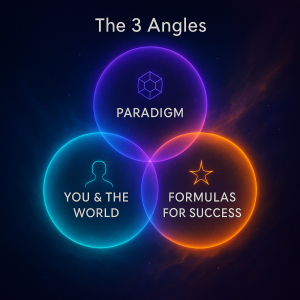
Here’s the truth: building your dream life isn’t about adding more to your plate. It’s about shifting the way you see, feel, and create in the world. At Paradigm Rhyme, we work with three angles that open the door to lasting transformation.

These angles aren’t abstract ideas. They are practical frameworks that connect ancient wisdom, modern psychology, and lived human experience. Think of them as lenses — ways of seeing yourself and the world that bring clarity, confidence, and alignment.


Angle 1: You and the World Around You

How you align your body, mind, and energy with the physical and energetic world.

Your lived experience can feel expansive or constricting. Amazing or unbearable. What makes the difference? How you work with your body, your mind, and the natural flow of life around you.

When you build connection, you build power. That connection starts within:

  • Body Connection → Feel alive in your skin. Prioritize fitness, health, and intuitive awareness. Learn to regulate your nervous system so you’re not just surviving, but actually thriving.
  • Mind Mastery → Stop running on autopilot. Reprogram your brain. Learn to think for yourself so your thoughts serve you instead of sabotage you.
  • Physical World Experience → Redefine “success” in a way that connects you to the world instead of isolating you from it. Flow with life, create purpose, and feel grounded in your day-to-day.
  • Energetic World → Understand the intersection of science and spirituality. See how natural laws shape your lived experience. Tap into the felt sense of being part of something bigger.

When body, mind, and energy work together, you stop fighting life and start flowing with it.


Angle 2: Paradigm

Upgrade the blueprint that runs your life.

Here’s a mind-bender: over 95% of your daily behavior is habitual. That means most of what you do, think, and feel is driven by old programming. If you’ve ever asked yourself, “Why do I keep repeating this pattern even though I know better?” — this is why.

Your paradigm is the invisible operating system of your life. Upgrade the paradigm, and your results change automatically. At Paradigm Rhyme, we break a paradigm down into six interconnected parts:

  • Beliefs → Mental programs that shape what you see as possible.
  • Stories → The narratives you tell and retell that either trap you or set you free.
  • Habits → The small daily actions that reinforce old cycles or open new ones.
  • Body → The foundation where stress, trauma, and energy live — and where transformation begins.
  • Relationships → The people and communities who mirror and reinforce your paradigm, either expanding you or pulling you off-center.
  • Results → The visible outcomes that show you exactly what paradigm is running in the background.

When you upgrade even one part of this system, the others shift. When you work across all six, your life changes in ways that stick.


Angle 3: Formulas for Success

Discovering your unique code for thriving.

Thriving as a human being doesn’t mean hacking your way through life — it means learning the natural laws that have always governed human experience. The yogis, sages, and mystics had much of this figured out, but today we can also draw from modern psychology, neuroscience, and performance research.

This angle is about uncovering the codes — the formulas that make life work when you live in alignment with them.

Some of the codes we work with include:

  • The Happiness Formula → What it actually takes to feel good, consistently.
  • Success Defined → Redefining success so it reflects authenticity, not just external measures.
  • Purpose × Passion → Finding the overlap of what you love, what you’re good at, and what the world needs.
  • Emotional Alchemy → Transforming fear, anger, and grief into growth, creativity, and clarity.
  • The Tools to Thrive → Practical practices like breathwork, meditation, and somatic resets.
  • Law of Vibration → Understanding how your energy influences the experiences you attract and create.

Your formula won’t look exactly like anyone else’s — and that’s the point. Authenticity is your ultimate success code.


Bringing It All Together

Building your dream life isn’t about chasing the next milestone. It’s about aligning your inner world with the outer world so that your daily experience becomes the proof of your transformation.

The three angles — You and the World Around You, Paradigm, and Formulas for Success — create a holistic path to thriving. Each one opens doors. Together, they create a new operating system for how you live, work, and create in this ultra-modern world.

In the next blogs, we’ll go deeper into each angle and its subtopics, giving you the practical tools and energetic upgrades to reprogram your life.

Because thriving isn’t just possible — it’s your birthright.

Finding Balance in the Ultra-Modern World: Why Our Nervous Systems Hold the Key to Thriving

We are living in 2025, a time of incredible progress and nonstop change. AI is coding, diagnosing, creating art, and transforming industries. Productivity has never been higher. Yet people are more anxious, burned out, and disconnected than ever.

Our bodies were not built for this. The nervous system that once helped us survive in the jungle now struggles under the weight of emails, deadlines, political stress, social feeds, and information overload. Our minds have adapted at breakneck speed, but our bodies have not caught up.

The Lay of the Land in 2025

The systems we live in today were designed for efficiency, not for human thriving. Our institutions, belief systems, governments, business, and more all formed as a response to context of the day in which they formed and grew. Human context and the knowledge that we have has changed…DRASTICALLY. Too often these old ways keep us producing but not healthy. Many valuable traditions — rest, ritual, community, connection to nature — have been lost along the way.

The result is a culture where stress and anxiety are the baseline. From the Sunday scaries to constant FOMO, people live in a cycle of “too much to do” or “not enough happening.” Many are settling for “ok” or “good enough,” even though deep down they are unhappy and held back by patterns they have not broken free from. The research and dire stats could fill up an encyclopedia. Here’s a few recent examples:

  • 83% of U.S. workers report workplace stress (Osha)
  • Depression and anxiety cost the global economy $1 trillion per year in lost productivity (World Health Organization)
  • 74% of adults in the US have severe hypertensions, leading to heart disease, strokes, and other issues (CDC)
  • Half of all adults in the US have high blood pressure and most do not know it (CDC)

Beyond Productivity: The Human Advantage

For most of human history, survival was the measure of success. Early humans banded together to hunt, gather, protect, and procreate. As tribes grew into villages and villages into cities, productivity became the currency of progress. We learned to farm, trade, and build systems. Business and commerce were always at the heart of this story.

But productivity came with a price. Our drive for “more” pushed civilizations forward, while slowly depleting the earth beneath us and eroding the joy within us. Industrialization brought speed, but also stress. Digitalization brought connection, but also overwhelm. Somewhere along the way, our nervous systems — designed in the jungle to face predators and storms — were asked to process emails, deadlines, and stock markets instead.

Now, we stand at another turning point. Artificial intelligence can out-produce, out-compute, and out-optimize us in countless ways. The old game of “more output equals more value” no longer makes sense.

Our true advantage is what machines cannot do. AI cannot regulate a nervous system. It cannot process grief. It cannot feel the spark of intuition that guides a new creation, or the alignment of purpose that drives real leadership. The next era of human success will not be about producing more, but about learning to live fully inside the body, to manage stress with skill, and to channel our energy into work and relationships that matter.

This is the opportunity: to reset our relationship with productivity, and reclaim our humanity as the edge that no algorithm can replace.

The Energetic System We Forgot

Modern science and ancient wisdom are surprisingly aligned. Neuroscience, somatics, quantum physics, Chinese medicine, yogic philosophy, and Buddhist psychology all point to the same truth: we are energetic systems.

At our core, we are mammals. When a gazelle spots a predator, its body immediately shifts into fight, flight, or freeze—muscles tense, breath shortens, adrenaline floods. When the threat passes, the gazelle shudders it off. A bear emerging from hibernation naturally disperses built-up energy. Human bodies operate the same way. Anxiety feels like tight shoulders, a shallow throat, or a clenching gut. Trauma lodges in fascia and neural loops, repeating until it’s released. But unlike wildlife, most of us never complete the cycle—we stay charged, scrolling, worrying, working, never settling the system.

Ancient cultures knew this intimately. You’ll struggle to find an indigenous tribe anywhere that didn’t drum, dance, or tell stories around fire to release fear or call in healing. Across generations and geographies, traditional medicine people helped communities move stuck emotion and reset collective energy. Anthropologists and historians document practices from powwow circles to Afro-Caribbean “medicinal drumming” rituals that consciously used rhythm, song, and ceremony to shift emotional field and group coherence. (NIH) (Open Access Gov)

Today modern science echoes these ancient truths. Polyvagal theory explains how our autonomic nervous system—especially vagal pathways—regulates safety and emotional resilience. Mindfulness and breathwork have measurable impacts on heart rate variability and PTSD symptoms. Somatic therapies, like Somatic Experiencing, help release tension by completing incomplete fight-flight responses stored in the body.

These ancient systems weren’t fringe, they were foundational. And science is now catching up.

This does not mean the mind isn’t vital. Our human brain is still the most powerful complex organ. But the mind alone (detached from body’s guidance) functions like a Ferrari parked in the jungle without a map. Beautiful, capable, and wildly out of context.

Why Talk Therapy and SSRIs Alone are Not Enough

Therapy has become part of the cultural fabric. Since the 1980s, usage has climbed steadily in the U.S., and today more than 40 million adults receive mental health treatment each year. It has helped reduce stigma, opened conversations, and given countless people language for what they are going through. For many, it is life-saving.

But here’s the hard truth: a lot of people feel like they’ve been in therapy forever, turning over the same problems again and again, with only incremental progress. I know this personally. For years, I sat across from therapists, talking through stress and challenges in my work and relationships. It gave me insights, but it rarely changed the way I felt in my body when anxiety or overwhelm hit. The patterns kept looping, no matter how much I “understood” them.

That is because talk therapy works mainly at the level of cognition. It can help you name the problem and even trace where it came from, but it does not always teach you how to feel safe in your own skin. When the nervous system is constantly stuck in fight, flight, or freeze, no amount of analysis makes the body relax. The result is that people end up managing symptoms rather than dissolving the root cause.

At some point, don’t we want more than just coping? Don’t we want to resolve the tension that lives underneath the story? That is where somatic practices come in. Breathwork, meditation, yoga, tapping, and trauma-informed movement all give the body a way to complete cycles of stress and discharge what was held. Mindfulness and nervous system regulation retrain your physiology so that when the outside world is chaotic, you can still find ground inside yourself.

The most effective healing I have seen is when therapy, medicine, and somatics are not competing silos but integrated approaches. Understanding the mind matters. But rewiring the body and restoring balance to the nervous system is what allows true change to take hold.

Here’s what science reveals: CBT (cognitive behavioral therapy) does reduce symptoms and can lower relapse risk in depression—reducing the chance of a new episode from about 41.3% to 31.6% within 12 months, according to a meta-analysis of nearly 4,000 people (NIH). But it doesn’t always stick. For many, what gets treated intellectually comes back physiologically.

Somatic therapies like Somatic Experiencing (SE) are showing promise for addressing the whole system. Preliminary studies indicate SE can reduce PTSD symptoms and improve general well-being in both trauma survivors and others. These practices help the nervous system actually reset, rather than just manage symptoms (NIH).


The Role of Ego and the ‘Culturescape’

The body gives us the first signals: shallow breath, tight chest, knotted gut. But what keeps those stress loops running is not just biology, it is the stories and conditioning in our minds. We often feel like we are making our own choices, but in reality much of life is lived inside invisible programming. Culture, family, religion, media, and peers all shape what we believe is normal. The nervous system fires, the ego takes the wheel, and suddenly we are repeating the same cycles again and again.

Most of us move through life on a kind of unintentional autopilot. We wake up, check our phones, go through routines, make choices that feel like ours — but in reality, much of what drives us is conditioning. The stories in our heads, the expectations of others, and the cultural codes we inherited create the rails we ride without even realizing it.

Ego is not the enemy, but it is often misunderstood. It clings to familiar patterns, judgments, and fears because that is how it maintains control. As Eckhart Tolle points out in The Power of Now, the moment you realize you can observe your thoughts is the moment you see the ego for what it is: a part of you, not the whole of you. I remember the first time I noticed that voice in my head and realized, “Wait, that isn’t me. That’s just a thought.” That crack of awareness was powerful. It gave me energy back I did not know I was losing.

Vishen Lakhiani calls this inherited programming the “culturescape” in his modern classic, The Code of the Extraordinary Mind. Built into it are what he calls “bullshit rules,” ideas we follow without questioning even when they do not serve us. In my own life, I absorbed the moral codes of evangelical conservative Christianity, the pressure of capitalism that tied my worth to output, and the idea of American exceptionalism that told me nonstop striving was the only way forward. These weren’t just ideas, they shaped my body’s stress response, my nervous system, and my sense of identity.

Many of us are still carrying versions of these bullshit rules today. We stay in jobs that look good but feel hollow. We normalize burnout as the price of ambition. We settle for “good enough” relationships or routines, while deep down we know we are not free. The body signals it. The mind rationalizes it. And the cycle continues.

Freedom does not mean rejecting everything from our past. Some traditions and structures carry wisdom worth keeping. But true freedom begins when we notice the culturescape and stop mistaking it for reality. When you realize the ego is not you, when you reconnect with the body as an anchor, you stop running the old code. You wake up. You reclaim energy. And life stops being an endless reaction, it becomes your own conscious creation.


The Six-Part Paradigm

All of this points to a bigger truth: thriving in the ultra-modern world requires more than just surviving our nervous system’s stress loops or questioning the cultural codes we inherited. It requires building a new paradigm for how we live, work, and create.

At Paradigm Rhyme, we frame this through six parts:

  • Beliefs: The mental programs that shape how we see ourselves and what we think is possible.
  • Stories: The narratives we tell and retell that either trap us or free us.
  • Habits: The daily actions that reinforce old cycles or open new pathways.
  • Relationships: The people and communities who either expand our capacity or pull us off center.
  • Results: The visible outcomes of the inner paradigm we’re running.
  • Body: The foundation where stress, trauma, and energy live — and where true integration begins.

This framework is not about rejecting the past, but integrating the best of ancient wisdom, modern science, and lived experience. When we start working across all six dimensions, we stop living on autopilot. We stop settling for “ok” or “good enough.” We reclaim energy, clarity, and presence — and life becomes something we create consciously, not just endure.

This is where the journey of Paradigm Rhyme begins. In the blog, we will go deeper into the Six-Part Paradigm and how it can unlock sustainable performance, authentic connection, and well-being in a world that is moving faster than ever.

Back to where this all started

A note from Brett Mackey, founder of Paradigm Rhyme:

Paradigm Rhyme was formed on July 7, 2023…and the first blog on the original site was published soon after. At the time, I was on the front end of a large shift in my life experience and everything felt new and often exciting. I poured my heart into that first blog. It was cathartic to share, to release. In hindsight, it was an early important step towards reclaiming control of my life direction. In the months that followed I learned that I had a lot to learn, and energetically it was not the right time for me to be sharing or teaching. I was in caterpillar mode and getting ready to cocoon…sort of. Below I am re-posting the original blog that kicked off the Paradigm Rhyme discovery journey, which continues until today. As I write this updated preface to the original blog, it’s August 31 of 2025, and I’m finalizing copy for the brand re-launch of Paradigm Rhyme’s website, to better serve our growing community. In the years since this post was written, so many lives have already been touched on the journey, none more than my own. Paradigm Rhyme started with just me, but it’s quickly become a team and a network that are on a mission to do good. We are so glad that you are here. Without further ado…the blast from the past:


Original Post:

TLDR: I was a business executive and former Big 4 consultant focused on digital transformation in my prior paradigm. Now I am embarking on a journey to live openly, learn from guides, and create a new paradigm focused on purpose, passion, and calling. 


When I went to bed last night I was an executive at a major US brand, committed to the corporate grind, and a deep belief that my decade of leadership at various large organizations had produced results that would continue to propel me up the corporate ladder. For better or worse, the past decade proved my values: grueling career centric mentality, relentless pursuit of promotion, leaning into my love of leadership, and finding ways to touch people’s lives as I navigated the beast.

What was missing across all this? Purpose. Passion. Calling. I knew there was a creative side dormant, and I longed for the time and space to pursue what I loved rather than focusing on status and wealth. Despite what my inner self knew I wanted, I had locked myself to the unending train of corporate advancement…and despite my better judgment continued to pump fuel into that engine.

Finding oneself out of a job through a lay-off is a perfectly natural part of the modern corporate ‘circle of life’, but before last week it was an experience I had not had during a 13 year sprint up the ladder where I rose from a technology analyst in a Fortune 100 insurance company (~4 years total), up through the Senior Manager ranks at a Big 4 consulting firm (~8 years total), and then becoming a Vice President at a major North American brand (~1 year). After experiencing the ‘setback’ of losing my job last week, my brain quickly drifted to the conventional wisdom: take a little time (but not too much time) to reset & update my resume, check-in with my network for help finding the next career move, and then jump back into the grind as quickly as feasible…lest I lose precious months of earning potential or ‘slow my momentum’. This sage wisdom from the religion of capitalism was definitely my first inclination..

…and yet a tiny voice deep within me was whispering something radically different, “Do you actually want to be on this business path that your ego is so desperate to get back to?”. The tiny voice made a solid point: I had spent the better part of the past 5 years complaining to my boyfriend that I worked too much and it was sucking away any hope of devoting time to topics I am passionate about. I had a long list of causes, artistic endeavors, travel, interests, spiritual practices, and people that I so deeply longed to dive into…but I continuously gave myself the same excuse for why I didn’t do this: I don’t have enough time. I had long succumb to a dull acceptance that because my corporate career afforded me the lifestyle to live comfortably, donate to causes I care about, allowed me to positively impact the people I worked with, and still provided enough time for me to be somewhat (though not fully) present for my family, my community, and my partner… this life was ‘good enough’ and I should just be grateful for what I had.

But what about what I didn’t have? What about the passions that I knew were at the core of my soul, that I allowed to die on the vine and slowly wilt away? Why should I limit my life to ‘good enough’, when there’s only one guaranteed trip on this planet and I have the potential to do so much more than ‘good enough’? I had been intentional about building my nest egg over the previous few years (after many years of less responsible over-spending), and I don’t have a family I need to feed. As I reflected on this inner guidance and gave it room to grow into bigger ideas, I felt a tidal wave of excitement and creativity hit me with a force that knocked my frown into a smile before I knew it.

As I meditated, wrote, and took counsel from trusted friends…the significance of this moment and the potential path forward became clear:


    •  I had been yearning for change but was too afraid to exit my prior path

    • The universe had forced my hand, giving me the gift of time and a chance at rebirth

    • I had almost missed the presence of this gift entirely, as I was so focused on clinging to the old paradigm

    • Now, a clear choice lay before me: continue with the old or forge something new

I choose new. While I am at the initial stages of forming what the new paradigm looks like…I have created a malleable structure to guide this new journey. The journey is for self discovery, and not for profit. I created a budget to validate that I could live without being a burden to others, and I am giving myself 12 months for the initial discovery journey. I will invest time into achieving better outcomes for causes I care about. I will explore my spiritual side in a way I’ve literally always longed to. I will not take another traditional job until I have completed this journey. I started a LLC so this journey has the opportunity to grow into something more, if that is what is supposed to happen.

I don’t know where I am going to be at the end of this exploration, but I catch glimpses of what I would like it to be, and I am in the process of digging into this desire so I can manifest it…it sounds like freedom and rhymes with purpose. It’s a life where I make decisions on meaningful outcomes to pursue on my terms, and where values aren’t a buzzword or mask to cover up reality…they are truly embodied and personified by what I do each day, each moment. It is a future where I build a legacy that I know my niece and nephew would be proud of.

Recently I listened to a Tim Ferris podcast called ‘How to Design a Life’ (what a concept) where he interviewed Debbie Millman. It was a spell-binding and meaningful 2.5 hour journey across failures, chance moments that changed everything, brutal life setbacks of the most horrifying kind, public and private embarrassessments, and through it all an endearing and humorous story of absolutely massive success by a human who showed so much persistence, despite her natural inclination to run from failure. Debbie’s story of failure and rebound is an archetype I will explore deeply through ParadigmRhyme.

In the weeks and months ahead, ParadigmRhyme will be my forum to tackle the topics of passion, purpose, and calling…..I am going to lean heavily on guides that I respect, published content that speaks to me, and spiritual practices that go back thousands of years. I plan to:


    • Reflect on the extensive content I’ll be absorbing from respected authors, profound spiritualists, and other impactful content creators

    • Share original interviews that I will be conducting with the ‘guides’ of this journey…people I’m lucky enough to know and who have great stories and enduring lessons to teach us

    • Publish poetry, an outlet I use to express my feelings and observations

    • Blog!!! Please come back regularly and follow this journey

If you’re interested in these topics or perhaps have a desire for your own paradigm shift, I hope my journey can be beneficial to you, and perhaps you’ll even decide to join me on it (or take your own new journey). If you took the time to read my first blog post…I am genuinely grateful for your interest. I would love to hear from you if you have ideas, feedback, tips, or anything else that’s on your mind (contact info at bottom of the page).

If you want to be part of this journey, please subscribe to the blog and consider following our new instagram @TheParadigmRhyme.

One note before I wrap up the week 1 summary: I am incredibly grateful for my life situation and I know that the journey I am on would be less feasible for many people. Although I was not raised in a home with a lot of excess finances sitting around, I got lucky with my own access to education and the well-funded career I built after completing college. I know that for many people riding the modern career train (or is it roller coaster?), the daily grind is a necessary course of action to keep families fed, retirement accounts growing, and health insurance intact. I also recognize how much passion people display when pursuing their calling, and for many folks that is the corporate world… this can also be an act of love and an act of selflessness to provide for others. There is so much I respect about the well-structured and highly efficient modern business world, and my journey is not to undermine or bash business as a whole…it is simply a demonstration that I think there’s a different path for myself beyond the mainstream corporate ladder. I will speak to these topics further in upcoming weeks, but I want to ensure that I openly acknowledge the privilege I have that enabled me to take this journey. I promise to not take that for granted as I create a new paradigm, a transformed life, and a different path to abundance.

The discovery journey is officially launched!…and none of us know where it will end. To kick-off the first full week of the journey, I am heading across the boarder to Mexico with plans to spend time in Tepoztlan and Mexico City. Wishing you love, gratitude, and an open heart.


-Brett